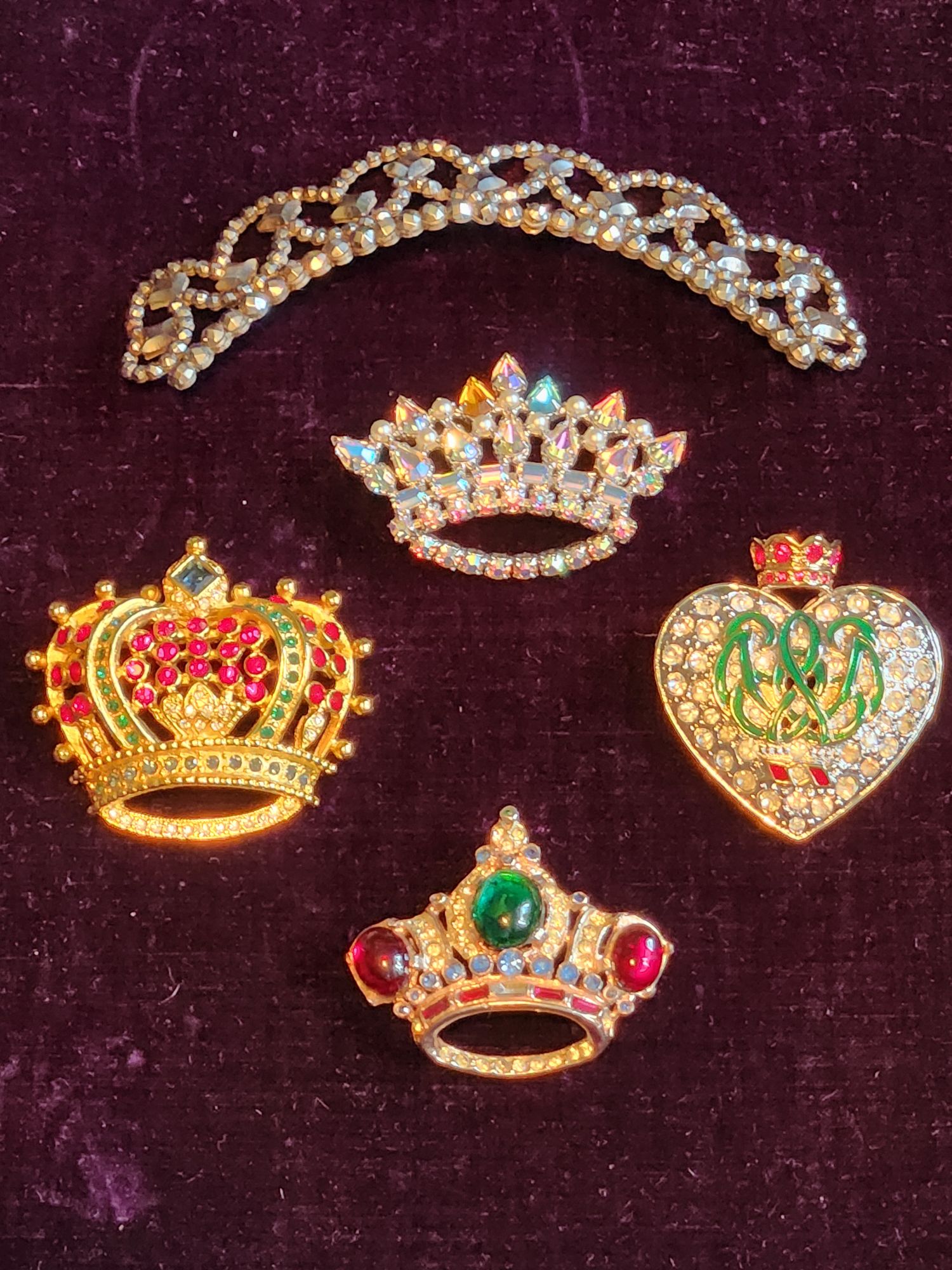
- The Court Jeweler
The recent interest in all things royal has also inspired a revival of crowns, tiaras, and reproductions of royal jewels.
The fascination isn’t new.
Royals have always given us a bit of inspiration through their jewels and heirlooms. Some of these pieces have survived wars, political upheaval, marriages, divorces, heartbreak, and tears. They have been worn at coronations, weddings, state occasions, and family gatherings, then carefully put away for another generation.
And every time a royal brings out a forgotten piece, the public takes notice.
Suddenly, something that has been sitting quietly in a vault for decades is everywhere. Designers reinterpret it. Jewelry houses create their own versions. Costume jewelry manufacturers make pieces inspired by it. And suddenly everyone wants a little bit of the royal sparkle.
But what is a crown without a monarch’s head to wear it?
Perhaps that is the fascination.
In recent years, coronations and other royal ceremonies have renewed interest in crowns, tiaras, and royal-inspired jewelry of nearly every variety. We don’t need a kilo of gold and a collection of enormous gemstones placed on someone’s head to understand the appeal.
The royal houses have been influencing taste and style for centuries.
And you don’t have to be royal to participate.
Crowns and tiaras are readily available today from jewelry houses at nearly every price point. But if we go back even a hundred years, we find that ordinary people were already buying their own versions of royal splendor.

A crown brooch might be purchased during a Jubilee year to commemorate the reign of a monarch. Small pins, pendants, brooches, and hair ornaments allowed someone of considerably more modest means to participate in the celebrations surrounding the Crown.
The United Kingdom has been particularly good at producing royal-inspired wares. Royal commemorative jewelry, china, silver, glass, and countless other objects have been produced for generations.
The French, on the other hand, have historically been a little more complicated about royal motifs.
After all, France had rather more experience with the consequences of removing a monarchy or two… or three?
Perhaps that is why British royal imagery has always felt so comfortable in the world of souvenirs and jewelry. A crown could be worn as a celebration, a keepsake, a fashion statement, or simply because it was pretty.

And then there is the influence of period dramas.
Shows set in the Georgian, Victorian, and Edwardian eras have given modern audiences a glimpse into just how important hair ornaments and jewelry once were. Not every woman was wearing a priceless tiara, of course. There was a hierarchy to jewelry just as there was to everything else.
A wealthy woman might have diamonds and pearls.
Another might have a tiara of paste stones.
Someone else might have sparkling cut steel.
And someone with even less might have Czech glass ornaments woven into her hair by a maid.
The same idea extended beyond the jewelry worn at grand occasions. Staff and working women could own brooches made from base metals and glass, sometimes designed to imitate the appearance of much more important jewels.

Royal jewelry could be reduced to the smallest possible scale and still retain the basic idea.
A brooch might echo a royal jewel.
A glass stone might imitate a precious gemstone.
A little crown might stand in for the enormous one sitting behind the glass in a museum.
That, perhaps, is the real charm of royal-inspired jewelry.
It allows the commoner to participate in the fantasy.
We may never have a royal vault.
We may never inherit a tiara.
We may never have a crown placed upon our heads while an entire nation watches.
But we can wear the brooch.
We can pin the little crown to our lapel.
We can put a sparkling hair ornament in our hair and pretend, if only for an afternoon, that we have somewhere terribly important to be.
Grand jewelry may be the reserve of royals and the extraordinarily wealthy. There is something undeniably enchanting about seeing those pieces behind bulletproof glass, knowing the stories they carry and the people who wore them.
But perhaps the little pieces are just as interesting.
Because they tell us something about the rest of us.
We have always wanted a little bit of the magic.
Sometimes a crown is made of gold and diamonds.
Sometimes it is glass, paste, or brass.
And sometimes, that is quite enough.

Cut Steel Regency Tiara Comb $1,000-
https://ebay.io/m/dpfeMy
Rhinestone Silver Tone Crown Brooch $70-
https://ebay.io/m/Do5qkQ
Rhinestone Gold Tone Crown Brooch $37-
https://ebay.io/m/DxaJvI
Rhinestone Sterling Silver Crown Brooch $90-
https://ebay.io/m/eBy6ae
Rhinestone Duchess Heart Crown Brooch $110-
https://ebay.io/m/IcJQ4K
Leave a Reply