- The Court Jeweler
There is something about carnelian in sunlight.
Turn the stone just slightly and suddenly it glows.
Not sparkles.
Glows.
It is one of those moments when a piece of jewelry stops being simply an object and becomes something else. Something almost metaphysical. You can understand why people have been drawn to colored stones for thousands of years. Before we knew the chemistry, before we had gemological charts and microscopes and appraisals, we simply looked at a stone and knew there was something about it.
Carnelian has that effect on me.
Perhaps it is because it looks like it came from somewhere much older than the jewelry that surrounds it.
The stone begins as part of the earth. Hard, rough, ordinary rock. And somewhere along the way, heat, minerals, pressure, and time create those warm oranges, reds, and translucent layers.
There is something rather profound about that.
The soft beauty comes from the rocky crags.
Scotland understood this particularly well.
There is a long tradition of Scottish jewelry made from local stones. Pebble jewelry and Scottish agate jewelry became especially fashionable during the Victorian era, helped considerably by Queen Victoria and Prince Albert’s love of the Highlands. Their enthusiasm for Scotland turned Highland imagery, tartans, local materials, and Scottish jewelry into fashionable souvenirs and adornments for visitors.
And importantly, these pieces were not reserved exclusively for the aristocracy.
Local lapidaries could take stones gathered from the Scottish landscape and turn them into brooches, bracelets, pendants, and other pieces of jewelry that were considerably more accessible than the grand jewels sitting in royal collections.
The landscape itself became the jewel box.
Agate, jasper, bloodstone, cairngorm, and other local stones were cut, polished, and set into jewelry. Each piece carried a little bit of the place from which it came.
That is part of what makes Scottish jewelry so interesting to me.
You aren’t simply buying a brooch.
You’re buying a piece of the landscape.
And carnelian sits beautifully within that tradition.
So what exactly is carnelian?
Carnelian is a variety of chalcedony, itself a form of quartz. Its colors range from pale orange and honey to deep red and reddish brown, with the richest colors often being the most sought after.
It is not an exceptionally rare gemstone.
And yet rarity isn’t always the point.
Sometimes the question isn’t How rare is it?
The better question is How does it make you feel when you look at it?
That is one of the things I have learned from sourcing.
Two pieces can have nearly identical monetary values and completely different levels of appeal.
One can sit on a table and be perfectly respectable.
The other catches the light from across the room.
You pick it up.
You turn it over.
You look again.
And suddenly you know why you bought it.
That is the eye.
And that is one of the things I want Royal Tea Company to be about.
Not simply Here is a piece of jewelry.
But:
Why this piece?
What did I see?
What made me stop?
Why did I pick it up when there were twenty other pieces sitting beside it?
Sometimes it is the workmanship.
Sometimes it is the history.
Sometimes it is the stone.
And sometimes it is simply the light.
A carnelian agate in the sunlight can make a rather convincing argument that beauty doesn’t need to be rare to be remarkable.
It only needs to be noticed.
Perhaps that is why I like these stones.
They remind us that some of the most beautiful things we encounter began as something completely ordinary.
A pebble.
A piece of rock.
Something beneath our feet.
Given enough time, enough skill, and someone willing to stop and look at it differently, it becomes jewelry.
And perhaps that is the real magic of collecting.
We don’t always find precious things.
Sometimes we find things that remind us why we find beauty precious.

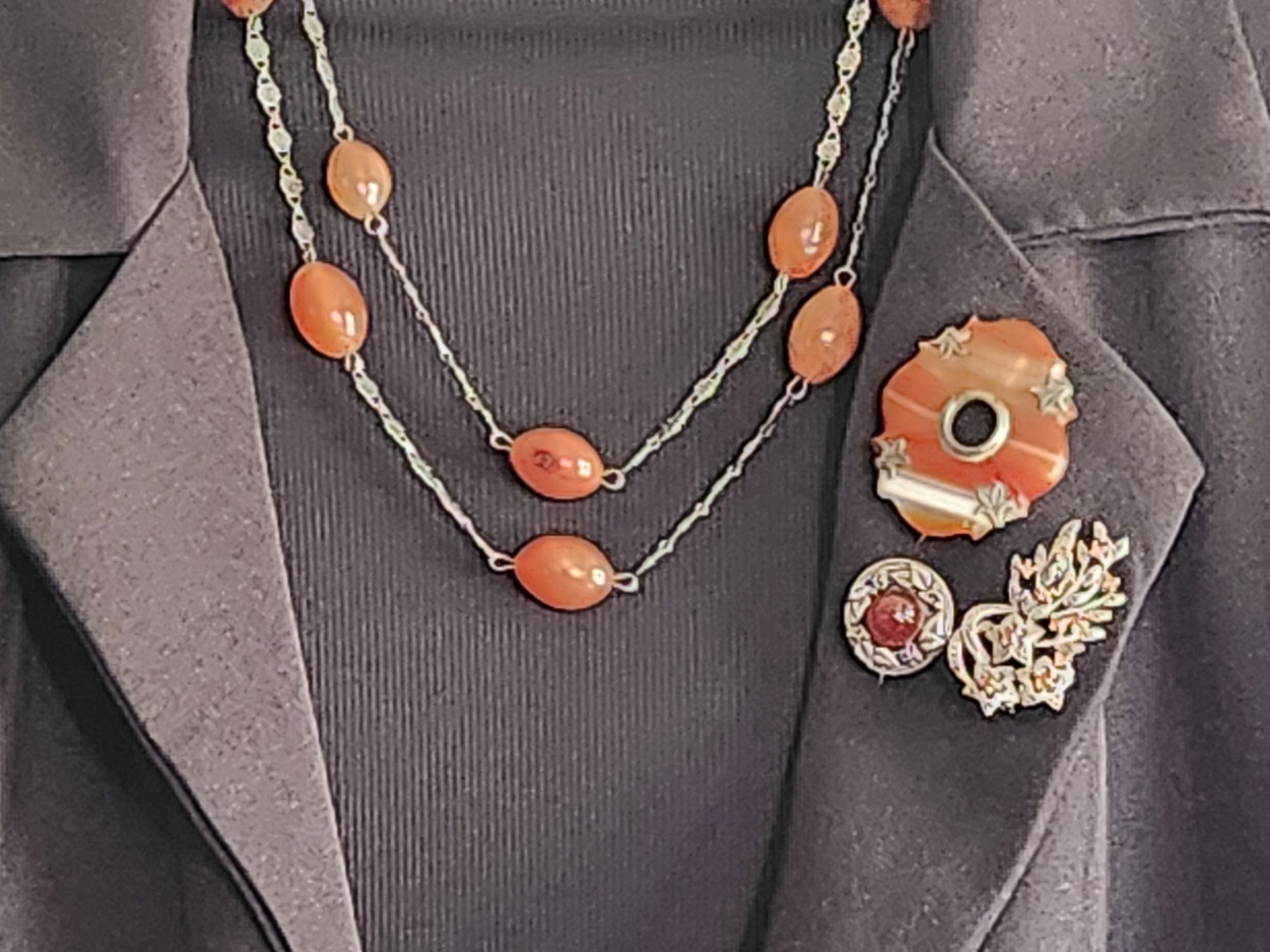
Carnelian and Silver Necklace $300-

Carved Carnelian and Silver Brooch $150-

Silver Carnelian & Marcasite Brooch $90-

Silver Carnelian Cabochon Brooch $90- SOLD
And this is exactly why I brought four pieces home with me from Scotland: three brooches and an opera-length necklace, all Scottish carnelian agate. I didn’t buy them because they were the rarest pieces on the table or because I expected them to be the most valuable. I bought them because each one had its own personality. The stones were different, the patterns were different, and the way each piece caught the light was different. They had individuality. They had beauty. And, most importantly, they made me stop and look. That is often enough for me. When something has visual interest that keeps drawing you back, when you find yourself turning it over just to see what the light will do next, I think you’ve found something worth bringing home.
Leave a Reply