- Court Circular
Dearest reader,
The ton is saddened once again.
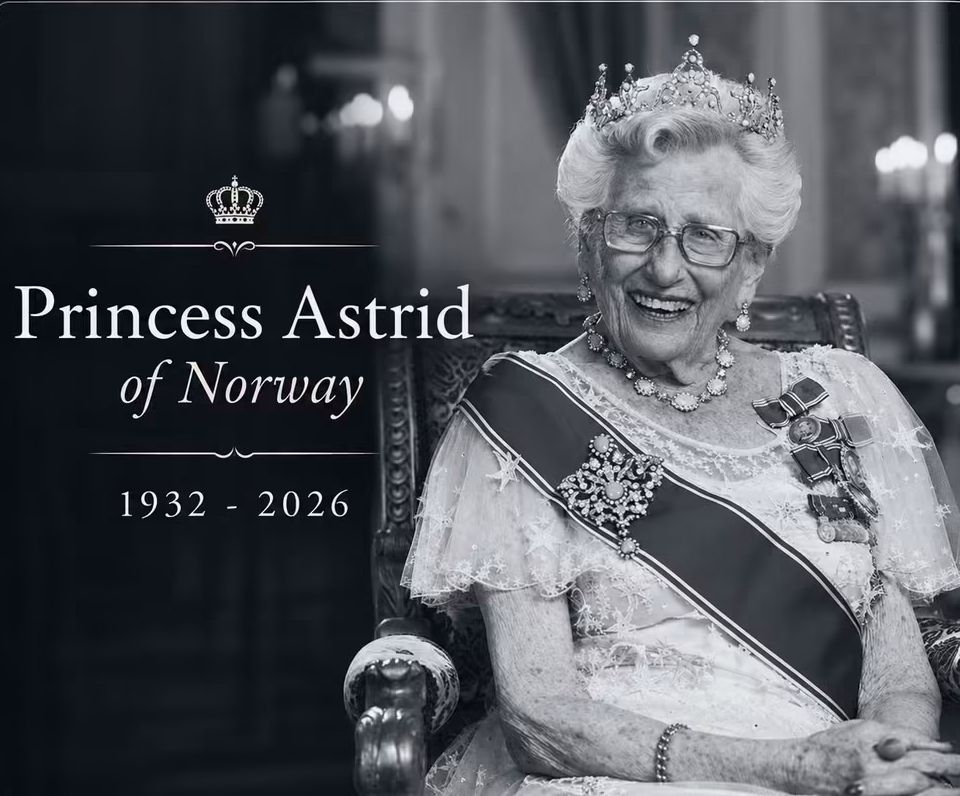
News has reached us from Norway that Princess Astrid, Mrs. Ferner, has died at the age of 94. And while Norway has endured more royal mourning than any nation should have to bear in such a short time, Princess Astrid’s passing deserves its own moment.
She was, by all accounts, the very definition of duty.
Daughter. Sister. Wife. Mother. And, at just twenty-two, unexpectedly called upon to become Norway’s First Lady following the death of her mother, Crown Princess Märtha, in 1954.
For fourteen years, Princess Astrid stood beside her father, King Olav V, representing Norway at home and abroad. And when that particular chapter ended, she did not exactly retire to the drawing room.
She kept working.
That was Astrid.
Loyal. Practical. Warm. And, as the new King Haakon VIII rather touchingly noted, never afraid to say what she thought.
One suspects that was occasionally rather useful at the palace.
So today, while Norway mourns, perhaps we might allow ourselves one small indulgence.
The jewels.
Because if there was one thing Princess Astrid understood, it was that duty need not require one to surrender one’s personality at the palace door.
Take, for example, her famous Ruby Aigrette.

Originally given to Princess Maud of Wales as a wedding present in 1896, the jewel became a part of the Norwegian royal collection and, following the division of the family’s jewels in 1968, into Astrid’s keeping.
And what a jewel it is.
Two ruby-and-diamond ornaments rise from the delicate frame like the antennae of some exceptionally well-dressed insect.
It is whimsical.
It is slightly eccentric.
It is utterly fabulous.
In other words, it was perfect for Princess Astrid.
And Her Royal Highness clearly knew it.
She reportedly joked that one antenna received signals from London while the other picked up Moscow.
Now that, dear reader, is the sort of royal humor we can get behind.
The aigrette could also be fitted with a pair of diamond wings, because apparently even royal jewelry believes in options.
And perhaps that is what I shall remember most about Princess Astrid.
She managed to be dutiful without being dull.
Traditional without being predictable.
And occasionally eccentric without requiring anyone’s permission.
There are younger royals who might take note.
One can serve the Crown and still have a little fun with the jewelry box.
As Norway mourns, I find myself hoping those ruby antennae make one final appearance when Princess Astrid is laid to rest.
It would be entirely appropriate.
The future wearer remains uncertain—the aigrettes are expected to remain with the Ferner family—but perhaps that is fitting too. Although a Crown Princess moment would also be fitting too.
Princess Astrid’s story was never really about the crown.
It was about what one does when duty comes knocking.
She answered.
Again and again.
For Norway, for her family, and for the people she served.
So rest easy, Mrs. Ferner.
The work is finished. The jewels remain. And the ton will certainly miss those antennas.
Leave a Reply