- The Jewels of the Ton
There are gemstones that sparkle.
There are gemstones that glow.
And then there is emerald.
Emerald does something entirely different. It has presence. Even a relatively small emerald can command attention simply by being green in a way that few other gemstones manage.
Perhaps that is why emerald has remained desirable for thousands of years.
The gemstone is a variety of beryl, with its distinctive green color created by trace amounts of elements within the stone. Ancient civilizations prized emerald, and some of the world’s most famous emeralds have come from Colombia. Egyptian emerald mines were being worked long before the modern jewelry industry existed.
Yet emerald’s appeal has never been confined to one particular period or style.
That may be one of its greatest strengths.
Emerald works beautifully in formal jewelry, but it does not require an elaborate setting to make an impression. It can be surrounded by diamonds and pearls, set into gold, carved into beads, or allowed to stand almost completely on its own.
It is remarkably adaptable.
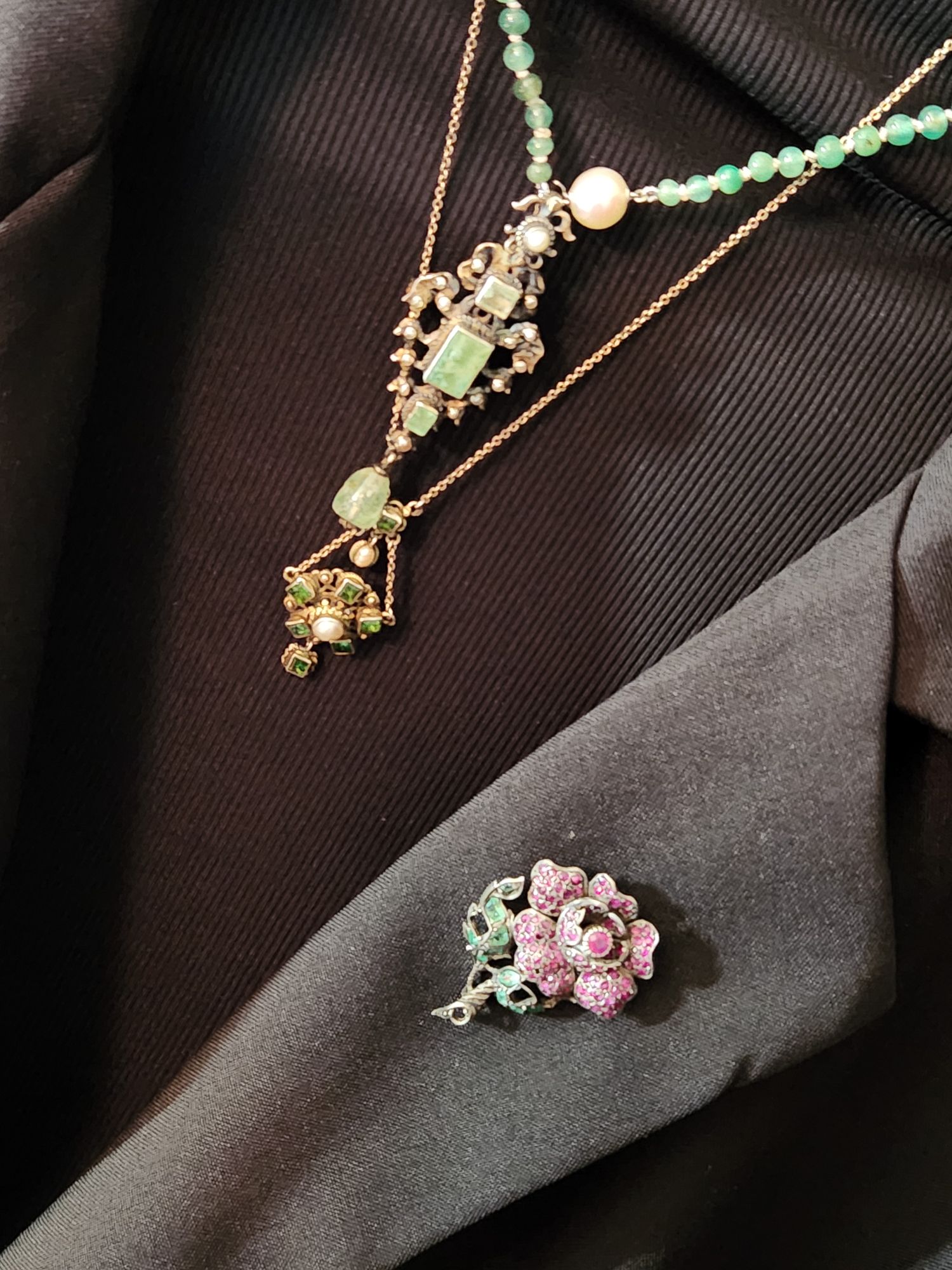
An Austro-Hungarian emerald and pearl brooch, for example, demonstrates just how naturally emerald works with pearls. The richness of the green gives the piece authority, while the pearls soften the overall effect. It is formal without becoming severe.
A gilt silver and emerald pendant takes an entirely different approach. Gold brings warmth to the cool green of the stone, creating one of those combinations that has remained popular because it simply works. There is no need to reinvent the relationship.

Then there is the ruby and emerald rose brooch.
Red and green can be a dangerous combination.
Handled poorly, the result can begin to look suspiciously festive.
Handled well, however, the colors become dramatic. The ruby brings warmth and intensity while the emerald provides the depth. Add the form of a rose and the result becomes romantic rather than seasonal.
And then there are emerald beads.
Beads offer something different again. Without an elaborate setting surrounding each stone, the material itself becomes the decoration. Variations in color, texture and natural inclusions become part of the design rather than something to be hidden.
This is particularly important with emerald.
The modern obsession with gemstone perfection can make inclusions seem like flaws. With natural emerald, however, inclusions are common. In fact, the internal characteristics of an emerald can be part of what makes a particular stone recognizable and interesting.

A completely clean emerald may be beautiful, but a stone with character can be far more fascinating.
There is something almost geological about looking into a good emerald and seeing evidence that it came from somewhere.
And that brings up one of the great misunderstandings about precious gemstones.
Rarity and beauty are not always the same thing.
A gemstone can be valuable because it is rare, but that does not automatically make it beautiful. Conversely, a stone does not have to be extraordinarily rare to stop someone in their tracks.
Emerald succeeds because it has personality.
The best examples seem almost to contain their own atmosphere. Deep greens can appear almost velvety, while lighter examples can have an almost watery quality. Under different lighting, the same stone can look remarkably different.
That makes emerald particularly successful in jewelry.
It changes as the wearer moves.
It changes with the light.
And it changes depending on what surrounds it.
Pearls make it softer.
Gold makes it warmer.
Rubies make it bolder.
Silver makes the green appear even cooler.
Black makes it dramatic.
Cream makes it elegant.
And suddenly a single gemstone can move from formal to romantic to theatrical simply by changing what is worn around it.
That versatility explains much of emerald’s longevity.
Victorian jewelers could use it.
Art Nouveau could use it.
Art Deco could use it.
Mid-century jewelry could use it.
And a modern jeweler can put a single emerald into a simple gold setting and make it look completely contemporary.
Emerald does not belong to one era.
It belongs to jewelry.
Perhaps that is why emerald continues to attract collectors. It offers enough history to satisfy the historian, enough variation to satisfy the gemologist and enough visual drama to satisfy someone who simply wants a beautiful piece of jewelry.
And, importantly, it does not always have to be worn quietly.
A strand of emerald beads can sit beside an elaborate antique brooch. A gold pendant can share space with a colorful ruby and emerald rose. Different periods, different techniques and completely different styles can somehow speak to one another.
Put them all together on the same ensemble and the emerald becomes the common language.
Is it excessive?
Perhaps.
But jewelry has never really been about necessity.
It is about beauty, personality and the occasional decision to put four different emerald pieces on the same outfit simply because they all deserve to be seen.
Emerald is not a shy gemstone.
It was never meant to be.

18″ Vintage Emerald Bead Necklace Pearl & Gold Clasp $3600-

Antique Silver Emerald & Ruby Rose $2600-

Victorian Gilt Silver Pearl and Emerald Pendant Necklace $700-

Austro-Hungarian Silver Pearl and Emerald Brooch/Pendant $1500-
Leave a Reply